🤖 Literally, in English
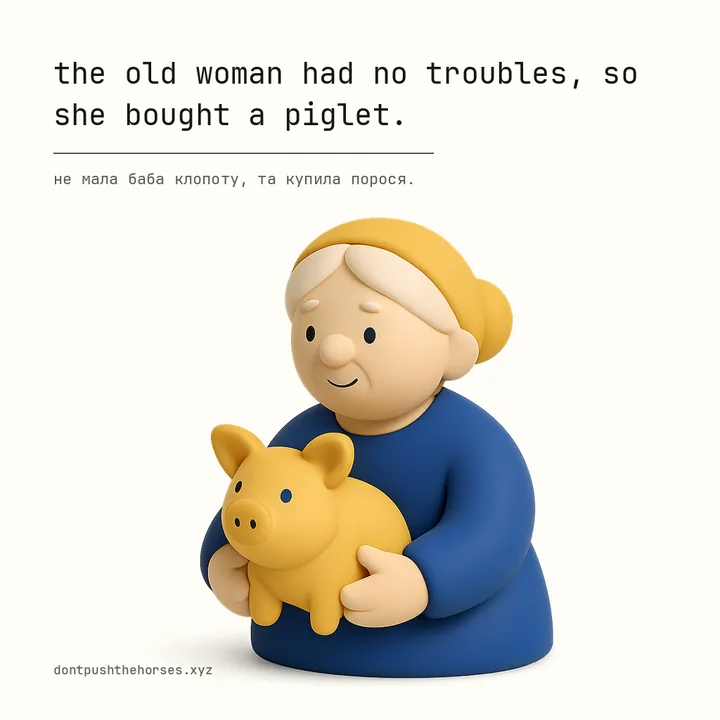
“The old woman had no troubles, so she bought a piglet.”
Не мала баба клопоту, та купила порося. Ne mala baba klopotu, ta kupyla porosia
🤨 What does it ACTUALLY mean? →
🇬🇧 What you'd actually say
“She created a problem she didn't need.”
also: “He went looking for trouble.” · “Nobody made him take that on.”
- 📖 Meaning
- Someone voluntarily took on an unnecessary problem.
- 💡 Why it's funny
- It reads as a complete short story with a beginning, a decision, and an implied disaster involving a pig.
- 🧭 Closest English idiom
- No direct English equivalent. English has 'to make a rod for your own back', which is close, but it implies future punishment. The Ukrainian is funnier and more specific: the person was perfectly fine and voluntarily acquired a problem.
- 📝 Explanation
- Said with amusement about pets, renovations, side projects and second jobs.
🧠 Learn
- ask for trouble (phrase) — to behave in a way that will cause problems — напрошуватися на проблеми “Lending him money is asking for trouble.”
- take on (phrase) — to accept a responsibility — брати на себе “She took on far too much.”
🗣 In context
Взяв ще одну роботу? Не мала баба клопоту…
He took a second job? He created a problem he didn't need.
🎧 Hear the contrast
dontpushthehorses.xyz