🤖 Literally, in English
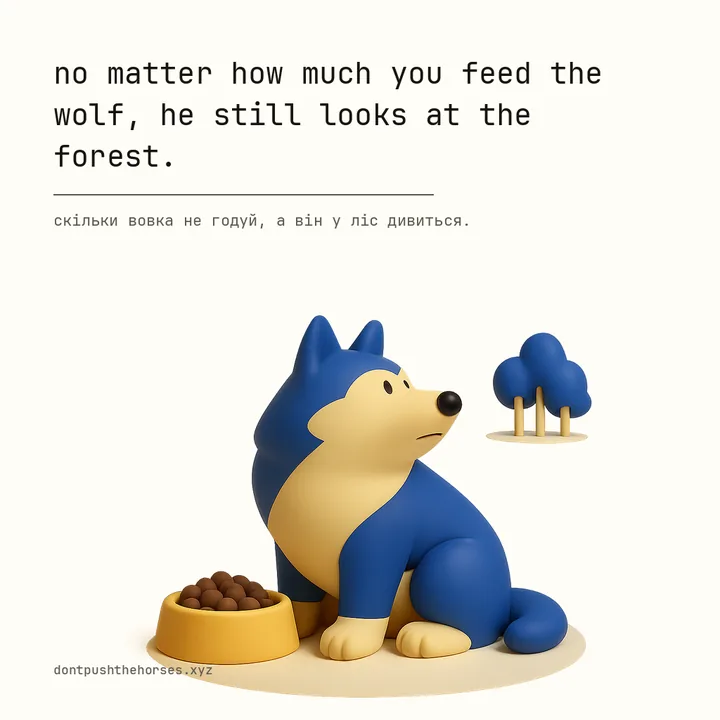
“No matter how much you feed the wolf, he still looks at the forest.”
Скільки вовка не годуй, а він у ліс дивиться. Skilky vovka ne hoduy, a vin u lis dyvytsia
🤨 What does it ACTUALLY mean? →
🇬🇧 What you'd actually say
“You can't change someone's nature.”
also: “A leopard can't change its spots.” · “Some people never change.”
- 📖 Meaning
- Someone's true character will show, no matter how well you treat them.
- 💡 Why it's funny
- English uses a leopard's spots; Ukrainian uses a wolf staring wistfully at the treeline, which is a much sadder image.
- 🧭 Closest English idiom
- “A leopard can't change its spots.”
- 📝 Explanation
- Usually said with disappointment about a person who returned to old habits or betrayed someone who helped them.
🧠 Learn
- nature (noun) — the basic character of a person — натура, вдача “It's not in his nature to apologise.”
- old habits die hard (idiom) — it is very difficult to stop doing what you have always done — звички важко змінити “He's back to smoking — old habits die hard.”
🗣 In context
Ми йому все дали, а він пішов. Скільки вовка не годуй…
We gave him everything and he still left. You can't change someone's nature.
🎧 Hear the contrast
dontpushthehorses.xyz